



Description
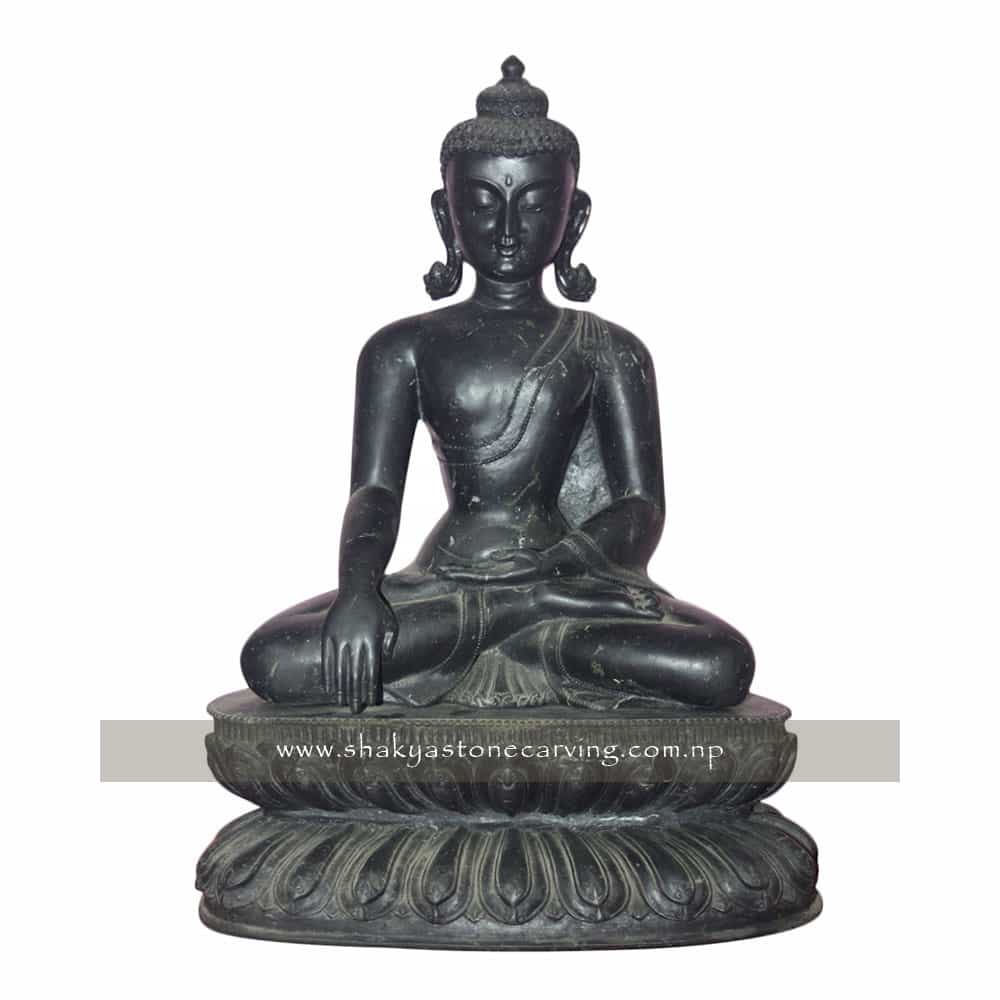
Shakyamuni Buddha (Tibetan: sha kya tu pa, sang gye. English: the Enlightened One, Sage of the Shakya Clan), founder of Buddhism.
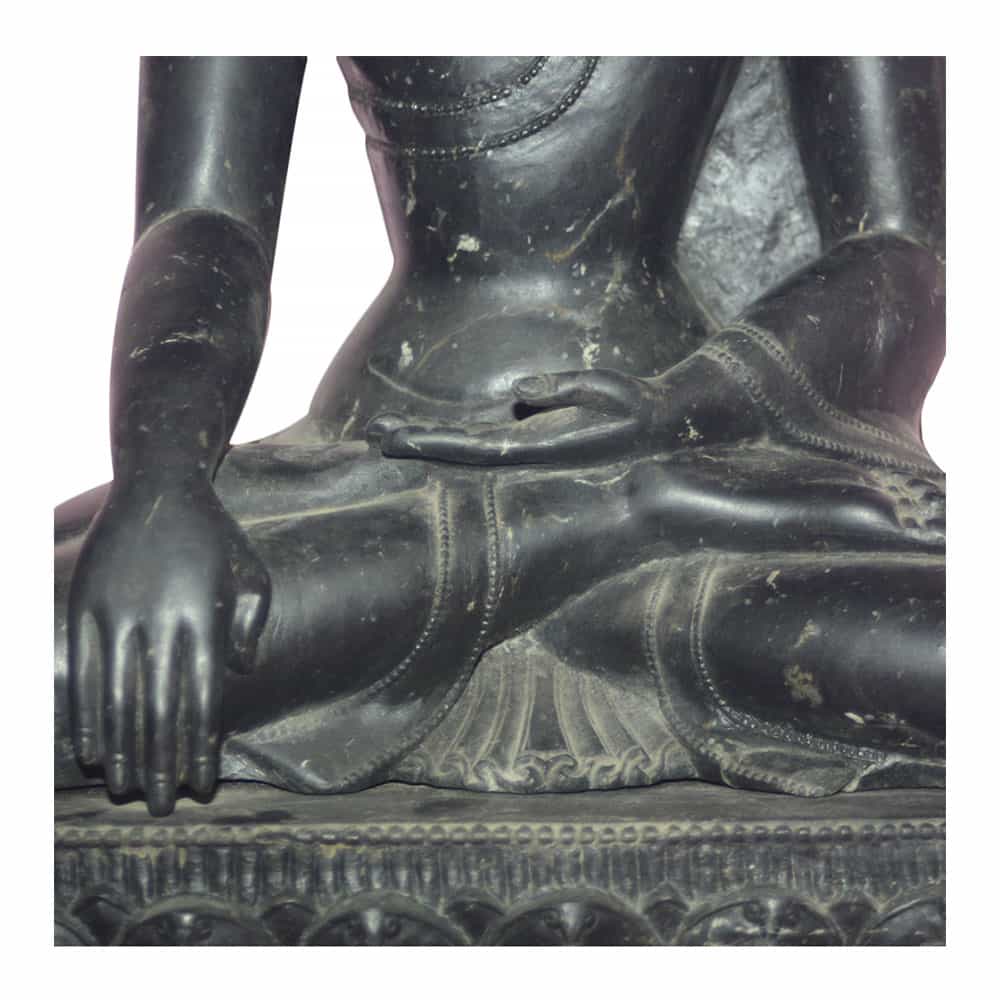
Formal in appearance, Shakyamuni Buddha typically gazes forward with partially closed eyes and the blue-black hair on the head is piled in a tuft on top with a single gold ornament adorning the crown. Between the eyebrows is a white dot (urna) and adorning the neck are three curved horizontal lines. The earlobes are long and pierced. With the right arm bare the right hand is extended across the knee in the earth touching gesture (mudra). The left performs the gesture (mudra) of meditation – palm upward in the lap. Across the left shoulder is a saffron coloured patchwork robe. A similar lower garment is tied at the waist with a cloth belt. The legs are folded in vajra posture.
“Born in the Shakya race through skillful means and compassion;
destroying the army of Mara who was unable to be destroyed by others;
with a body radiant like a mountain of gold.
Homage to you, King of Shakya.” (Tibetan liturgical verse).
A Buddha is known for having thirty-two major and eighty minor distinguishing physical characteristics (marks) based on the Indian cultural description of a Universal Monarch (Chakravartin) – the highest and most developed male form. Only a few of these 112 marks are depicted in art such as the ushnisha on the top of the head, the urnakesha between the eyes, three curved horizontal lines on the neck, a Dharma Wheel impression on the palms of the hands and soles of the feet.
Vajra Posture: a Buddhist term referring to a seated position where the feet are placed sole up on the thigh of the opposite leg; right over left. In the West this posture is almost universally referred to as the lotus posture because that is the name used by the major Hindu traditions and in Hatha Yoga, subjects which are generally more familiar to Western audiences. The location of the Buddha’s enlightenment in India, now called Bodhgaya, is called Vajrasana in Buddhist literature. The posture the Buddha sat in while reaching enlightenment is the vajra posture, and the highest meditation (samadhi) that is accomplished on reaching Buddhahood, in this vajra location and seated in vajra posture, is vajra samadhi.
Although we often speak of “the Buddha,” there are many Buddhas in Buddhism. On top of that, the many Buddhas come with many names and forms and play multiple roles. The word “Buddha” means one who woke up,” and in Buddhist doctrine, any such enlightened individual is technically a Buddha. In addition, the word Buddha is often used to mean the principle of Buddha-nature. But of course, there is one historical figure that normally is considered the Buddha.
Shakyamuni Buddha is a name given to the historical Buddha, especially in Mahayana Buddhism. So it’s nearlyalways the case that when someone is talking about Shakyamuni, he or she is speaking of the historical figure who was born Siddhartha Gautama but then became known as Shakyamuni only after he became the Buddha. This person, after his enlightenment, is also sometimes called Gautama Buddha.
However, people also speak of Shakyamuni as a more transcendent figure who still is, and not as a historical figure who lived a long time ago. Especially if you are new to Buddhism, this may be confusing. Let’s take a look at Shakyamuni Buddha and his role in Buddhism.
The Historical Buddha
The future Shakyamuni Buddha, Siddhartha Gautama, was born in the 5th or 6th century BCE in what is now Nepal. Although historians believe there was such a person, much of his life story is shrouded in legend and myth.
About the Shakya
The name Shakyamuni is Sanskrit for “Sage of the Shakya.” Siddhartha Gautama was born a prince of the Shakya or Sakya, a clan who appear to have established a city-state with a capital in Kapilavatthu, in modern-day Nepal, about 700 BCE. The Shakya were believed to have been descendants of a very ancient Vedic sage named Gautama Maharishi, from whom they took the name Gautama. There is a bit of legitimate documentation of the Shakya clan that can be found outside of Buddhist texts, so it appears the Shakya was not just an invention of Buddhist story-tellers.
If indeed Siddhartha was the heir of the Shakya king, as legends suggest, his enlightenment may have played a small role in the clan’s downfall. The Prince had married and had fathered a son before he left his home to seek wisdom, but the son, Rahula, eventually became his father’s disciple and a celibate monk, as did many young men of the Shakya nobility, according to the Tipitaka.
Early scriptures also say the Shakya and another clan, the Kosala, had long been at war. A peace agreement was sealed when the Kosala crown prince married a Shakya princess. However, the young woman sent by the Shakya to marry the prince actually was a slave, not a princess–a deception not discovered for a long time. The couple had a son, Vidudabha, who swore revenge when he learned the truth about his mother. He invaded and massacred the Shakya, then annexed Shakya territory into Kosala territory.
This happened near the time of the Buddha’s death. In his book, Confessions of a Buddhist Atheist Stephen Batchelor presents a plausible argument that the Buddha was poisoned because he was the most prominent surviving member of the Shakya royal family.


Reviews
There are no reviews yet.